
 Ritec partner
Flame Arresters
KITO is our brand for flame arresters. We take care of sizing, selection, supply, spare parts and service. KITO →
In-line and end-of-line deflagration and detonation flame arresters for explosion groups IIA to IIC, ATEX certified.
Also known as: flame arrestor, detonation arrester, deflagration arrester, flame trap.
Your request
Add this to your request. We come back with a quotation or the right part.
We will ask for: Tag number, Serial number.
Models
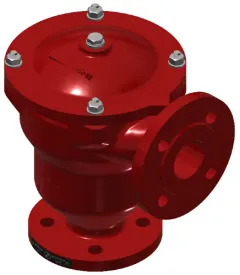
End-of-line2
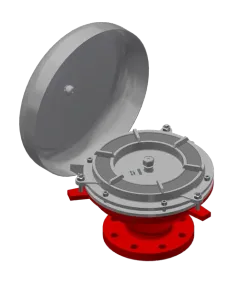
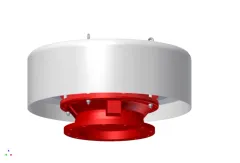
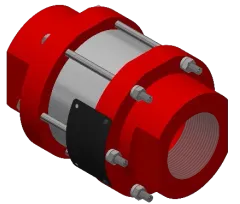
In-line4
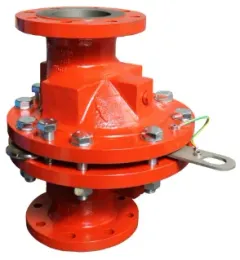
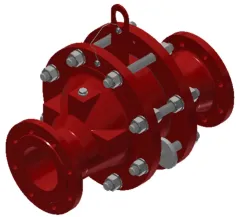
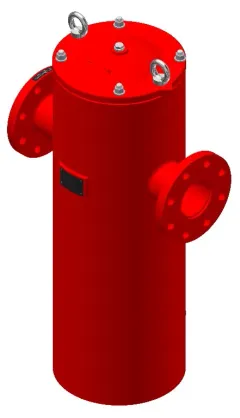
Liquid2
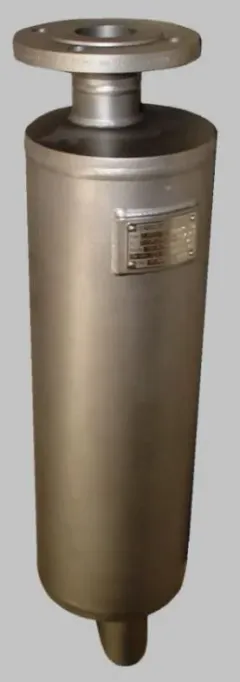
Accessories2
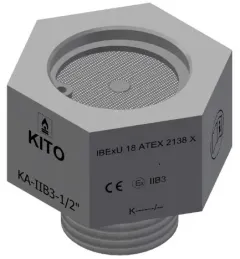
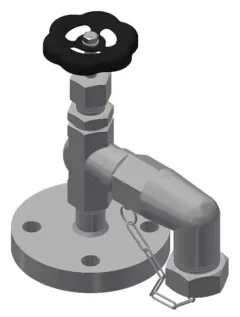
No models match these filters. That does not mean we cannot supply it:
Send us your requirement →Not seeing the size, connection or rating you need? Most of these models are built to order and our suppliers' engineers adapt them. Send us what you have and we work it out. Send us your requirement →
Wherever flammable vapours or gases flow through pipework, an ignition at one end can travel through the line to the tank or plant at the other end. A flame arrester interrupts that path. Ritec represents KITO Armaturen, a manufacturer of flame arresters in Braunschweig for over 90 years, in Belgium and the Netherlands. We determine the right type and location, size the arrester on flow and pressure drop, and supply it with its EC type examination certificate.
How a flame arrester works
The heart of every flame arrester is an element of wound, corrugated metal ribbons. A flame has to pass through thousands of narrow gaps and gives up its heat to the metal on the way. Below the ignition temperature the flame goes out. The gas itself flows through almost unhindered; the pressure drop is set by the element size. The element is replaceable and can be cleaned.
Types
End-of-line deflagration arresters mount on free tank vents and vent stacks. They protect against a flame from the atmosphere and are available in versions for short-time or endurance burning, up to DN800.
In-line deflagration arresters are installed in short pipe runs close to the possible ignition source, where a flame cannot yet accelerate into a detonation.
In-line detonation arresters have a shock absorber and are tested for stable and unstable detonations. They can be installed anywhere in the line and are the standard choice for vapour recovery units, vent headers and flare lines. They come in straight and angular designs, and threaded for small-bore lines.
Liquid detonation arresters protect tank filling and suction lines with a liquid seal, for the case where the line runs empty.
Breather valves with flame arrester combine the pressure and vacuum function of a tank with flame protection in one fitting.
Accessories such as condensate drains with flame arrester and sampling devices close the small openings that are often forgotten in an explosion safety review.
Explosion groups and MESG
Selection starts with the medium. Based on its maximum experimental safe gap (MESG) to IEC 60079-20-1, the gas is classified into explosion group IIA1, IIA, IIB1, IIB2, IIB3, IIB or IIC. An arrester is approved for a given group and covers all groups with a wider gap. The operating temperature and absolute pressure are limited by the approval as well: at higher pressure and temperature a flame is harder to quench.
Selection and pressure drop
An undersized arrester causes excessive pressure drop and restricts tank breathing; an oversized one is needlessly expensive. We size on the maximum flow and the allowable pressure drop, and check that the arrester matches the breather valve or emergency vent on the same tank. Temperature sensors, heating jackets and drains are specified along with it.
Standards and certificates
Flame arresters are supplied with EC type examination to ATEX 2014/34/EU and tested to EN ISO 16852. KITO is also certified to ISO 9001 and to the Pressure Equipment Directive (PED) for the pressure-bearing housings.
Frequently asked questions
- What is a flame arrester?
- A flame arrester (also spelled flame arrestor, or called a flame trap) is a fitting without moving parts that lets gas flow through but stops a flame. The element consists of wound, corrugated metal ribbons forming narrow gaps. A flame entering the element loses so much heat to the metal that it is extinguished before it reaches the other side.
- What is the difference between a deflagration and a detonation arrester?
- In a deflagration the flame front moves slower than the speed of sound; in a detonation the flame accelerates in a pipe into a shock wave faster than sound, with much higher pressures. A deflagration arrester may only be installed close to the possible ignition source, where the flame cannot yet accelerate. A detonation arrester has a shock absorber and a heavier element and can be installed anywhere in the line.
- What do explosion groups IIA, IIB and IIC mean?
- Gases and vapours are classified by their maximum experimental safe gap (MESG). Group IIA (propane, petrol, solvents) has the widest gap and is easiest to stop; IIB (ethylene, with IIB3 for example for ethylene oxide) is harder; IIC (hydrogen, acetylene) requires the finest elements. An arrester approved for IIC also covers all lower groups.
- What is endurance burning?
- When an escaping vapour-air mixture ignites at an end-of-line arrester, the flame can keep burning on the element. An arrester tested for short-time burning withstands this for a limited time, after which a temperature sensor must shut the process down. An arrester approved for endurance burning keeps protecting the tank for hours.
- Where should a flame arrester be installed?
- Anywhere an explosive mixture can travel through a pipe or opening from a possible ignition source into a space that must be protected: free tank vents, vapour recovery lines, upstream of flares and incinerators, gas analyser lines, and tank filling and suction lines. The position determines whether a deflagration or detonation arrester is needed.
- What information do you need?
- The medium and its explosion group or MESG, the installation point (end-of-line or in-line, distance to the ignition source), the nominal size and flange standard, the operating pressure and temperature, the maximum flow and allowable pressure drop, the material, and the accessories required, such as a temperature sensor or heating jacket.