
Fittings
Double-ferrule compression tube fittings, weld fittings, threaded and forged steel fittings for instrument tubing, in stainless steel and special alloys.
Also known as: tube fittings, compression fittings, double ferrule, Megalok, Meceweld, Meceprim, ASME B16.11.
Your request
Add this to your request. We come back with a quotation or the right part.
We will ask for: Tag number, Serial number.
Brands

Models
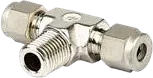
No models match these filters. That does not mean we cannot supply it:
Send us your requirement →Not seeing the size, connection or rating you need? Most of these models are built to order and our suppliers' engineers adapt them. Send us what you have and we work it out. Send us your requirement →
Instrument tubing connects a process tap to a gauge, transmitter, analyser or control device. The joints in that line have to be tight for years, survive vibration and thermal cycling, and still come apart for maintenance. Ritec supplies Mecesa fittings for those joints: Megalok double-ferrule compression fittings, Meceweld weld fittings, Meceprim threaded fittings and Serie 3000 and 6000 forged steel fittings to ASME B16.11, in stainless steel and special alloys.
How a double-ferrule fitting works
The fitting body has a seat for the tube. The tube slides in, and two ferrules sit between the tube and the nut. Tightening the nut drives the front ferrule into the seat, where it seals against both body and tube. The back ferrule is pushed under the front ferrule and grips the tube, holding it against pressure and vibration. Because the ferrules do the work, the tube itself is not deformed beyond a slight swage, and the joint can be opened and remade.
Choosing the fitting
Start with the tube: outside diameter, wall thickness and material. The wall thickness determines how much pressure the joint can take and whether an insert is needed on soft tube. Then match the thread standard on the other end to the instrument or valve, and choose the body material for the medium. For corrosive or high-temperature service, special alloys are available; for compressed air and water at low pressure, brass may be enough.
Weld, threaded and forged fittings
Weld fittings are used where the plant standard calls for welded tubing or where a mechanical joint is not acceptable. Threaded fittings in the light series adapt between thread standards and sizes at gauges, valves and manifolds. Forged steel fittings to ASME B16.11 in Class 3000 and 6000 take the step from small-bore process piping to the instrument line.
What we supply
Fittings from stock or short lead time, in the material and thread standard your plant uses, together with the matching needle valves, ball valves and manifolds from the same manufacturer. Send us the tube size, material and thread standard and we prepare a hook-up list.
Frequently asked questions
- What is a double-ferrule compression fitting?
- A tube fitting with a body, a nut and two ferrules. When the nut is tightened, the front ferrule is pressed between body and tube and makes the seal, while the back ferrule bites into the tube and holds it against pressure, vibration and pull-out. The tube needs no flaring, threading or welding.
- Which tube materials can be used?
- Stainless steel, carbon steel, copper and plastic tube, provided the tube is within the wall thickness range the fitting is designed for. The fitting body is normally 316 stainless steel; brass and special alloys such as Monel, Inconel, Hastelloy, duplex and titanium are available for specific media.
- Which thread standards are available?
- NPT to ASME B1.20.1 and ISO 7 R/Rp are standard; ISO 228 parallel and metric DIN 3852 (forms B and X) are optional. Tell us which standard your instruments and valves use so the whole hook-up matches.
- When do you use weld fittings instead of compression fittings?
- Where a demountable joint is not wanted, for example on permanent high-pressure or high-temperature runs, or where plant standards require welded tubing. Weld-to-tube adapters let a welded run end in a compression joint at the instrument.